An open science-fantasy setting
Aetheria
People can engineer bodies, upload minds, and build fleets. Agreeing on what they should do with that power is harder.
Aetheria follows a civilization whose technical abilities grow faster than its collective judgment. Corporate powers, engineered peoples, uploaded minds, habitats, fleets, and political movements increasingly depend on one another. They still disagree about who deserves recognition as a person, who gets to direct progress, and who bears its costs.
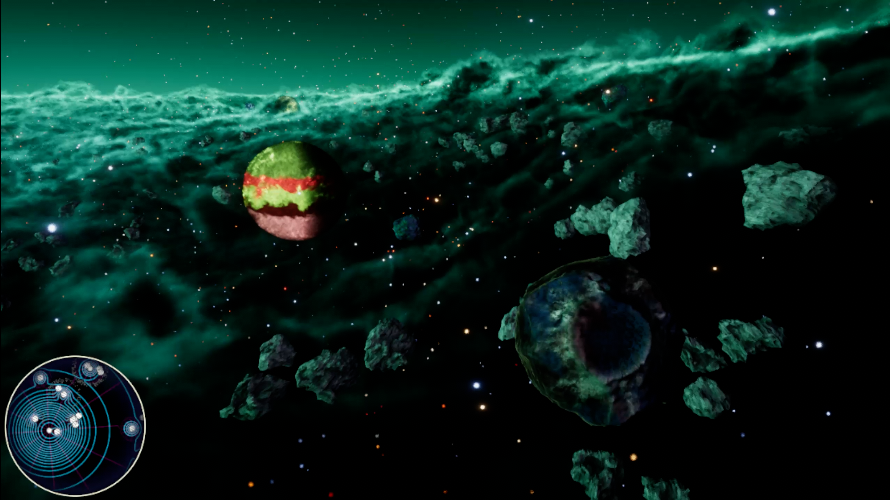
Gameplay preview · Fly the ships; see the industry and entrenched powers behind them.
The fracture
A civilization displaced into Elysium
Humanity's first successful faster-than-light experiment triggers a quarantine response. It displaces an interconnected civilization into Elysium, where physics works differently. People arrive with the systems that sustain and constrain them: maintenance, debts, legal claims, labor conflicts, military habits, memories, and compromises on which lives already depend.
This event divides the setting into two eras. Pre-Elysium stories draw on hard science fiction, industrial horror, corporate logistics, and noir. Post-Elysium stories also include unusual mental abilities known as esper cognition, cultivation traditions, necrotech, impossible weather, and giant humanoid spacecraft. These new possibilities still have practical costs: people need supplies, working machinery, and ways to live with the consequences of what they do.
Choose a route
Find your way into Aetheria
Explore the open vault through its history, stories about people's lives, or the designs and prototypes that make it playable.
Stories Across The Setting
Aetheria makes room for very different genres while keeping track of how events happen and what they change:
- Pre-Elysium hard science fiction and black magic: heat and habitat engineering determine what can stay alive; cognition markets and labor control shape whose abilities can be bought and directed. Dangerous research leads toward the FTL Trigger.
- Noir and institutional mystery: investigators face custody disputes, insurers and ports controlling access, contradictory records, and media pressure. Crimes can arise from decisions spread across several respectable offices, each holding only part of the authority.
- Post-Elysium mecha and cultivation drama: pilots of the Daedal Houses learn to operate ship-scale vessels called Figures as extensions of their own bodies. Wavecrafters preserve the knowledge needed to operate their technology through practiced forms, guild discipline, and guarded teaching lineages.
- First contact: species such as the Ratfolk have diverse communities, accessibility needs, and political disputes of their own. An outsider asking for a single representative gives them reasons for distrust.
- Corporate, domestic, or workplace stories: decisions about food, cooling, credentials, medicine, repair, transport, and shelter shape people’s lives. Nobody needs to fire a weapon for those decisions to become political.
Two complete novels · Free to read
Two distant corners of one history
Both novels stand alone and are available online or as EPUB downloads.
Pirate workplace space opera · warm black comedy
The Burden of Proof
Luce Orsino is determined to rescue people. He keeps building institutions that can end up owning the people he wants to save. Across four ships and repeated tactical catastrophes, one machine person needs the right to stop being needed.
Political mecha-academy thriller · adult/YA crossover
The Body That Asks
Five cadets are chosen to become the ideal family for a giant war machine. A damaged machine person becomes its sixth member. The body they form can function only if every participant retains the ability to say no.
Where Stories Begin
Aetheria’s conflicts often begin with a practical decision that cannot wait for agreement:
- A new technology works, but people have not agreed whether it should exist.
- One transaction recognizes someone as a person; the next treats them as property.
- A transformed body gains abilities, but fewer people are permitted to maintain it.
- Two credible records contradict each other. A port, crew, or court still has to decide what to do.
- The kindest available action keeps part of a harmful institution operating.
- Rescuers need temporary authority, then find reasons to keep it after the rescue.
- A sanctuary must decide how to keep welcoming people without using up the resources and strength of those already inside.
- Maintenance workers can see a system failing while its official dashboard still reports that it works.
People also work to make other choices possible. They provide food, cooling, truthful records, disability access, refuge, repair, and transport. Sharing authority matters too: those receiving help need enough say to refuse what others propose to do to save them.
Writers can take responsibility for a cast, a place, and the events they depict without having to control the entire universe. Their stories must respect the setting’s shared constraints. Narrative Themes explores its recurring tensions; the writing process and repository are open to inspection and contribution.