Aetheria: Starbridge Key-Art Brief
Production artifact
This brief directs promotional image production. It is not setting canon, a gameplay specification, or evidence of implementation. Where it conflicts with the current Starbridge game design document or worldbuilding owner notes, those sources prevail.
Asset And Delivery
Create a cinematic panoramic hero image for Aetheria: Starbridge, suitable for the website, store capsules, and wide promotional crops. Preserve the central defensive relationship when cropping: station rim below, four defenders across the middle, and attackers pressing inward from the far field. Keep important ships and effects away from the extreme edges so narrower crops do not reverse or erase the scene.
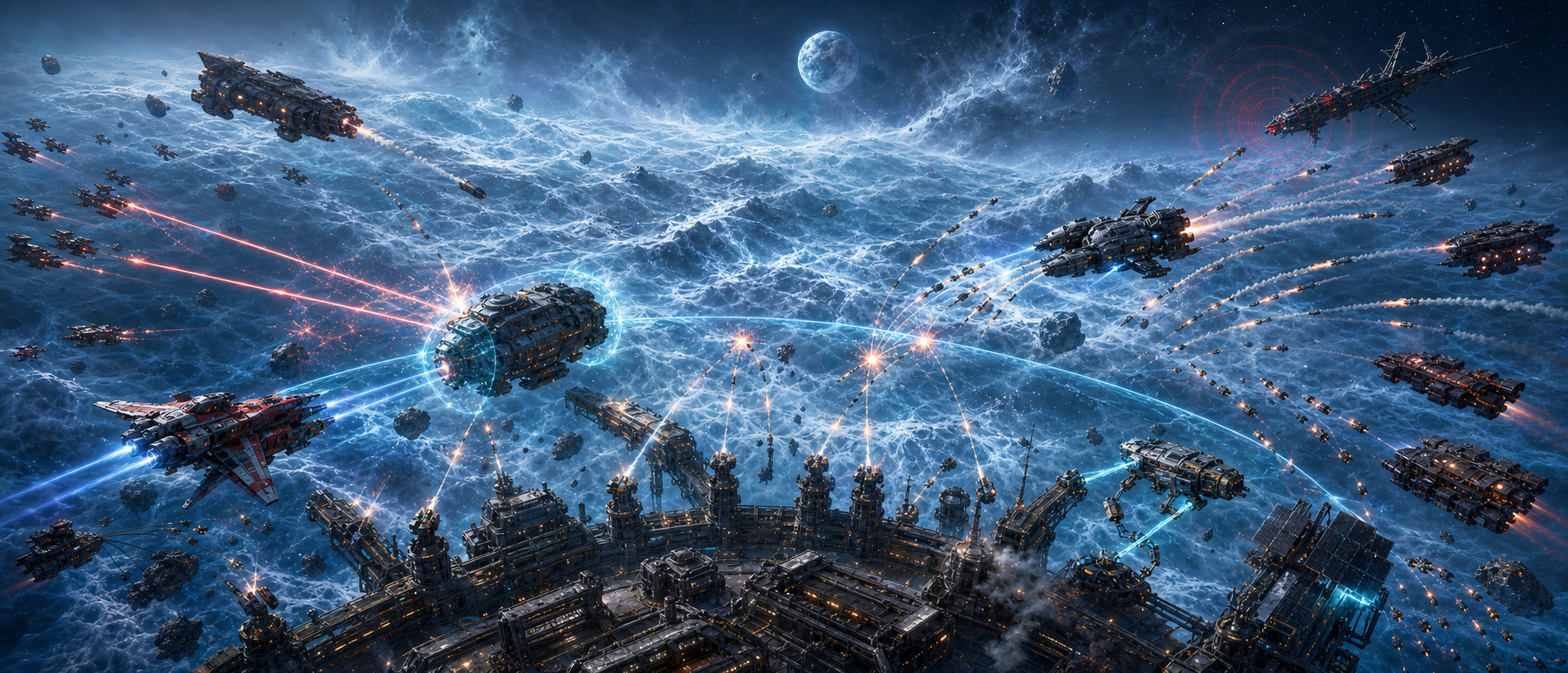
The adopted reference image is starbridge-promo-outward-panorama.png. Use it as the current composition reference, not as independent evidence for lore or mechanics.
Visual Promise
The image must communicate the cooperative concept in one glance: one station, four distinct player ships, and a siege that requires different jobs. The viewer is perched above the station looking outward across a luminous battlefield. Defenders form a readable protective line. Enemy movement and fire converge inward. Every vector must answer the basic question of who is protecting whom.
Camera And Composition
Use a wide-angle camera above and slightly behind the station, looking outward rather than straight down. The station core sits below the camera and outside the frame. Only its upper rim occupies the bottom foreground: shield emitters, point-defense turrets, docking-arm tips, radiator edges, service gantries, and glowing industrial infrastructure.
Beyond that rim, a curved shield perimeter crosses the middle band. Arrange four medium-sized defender ships along it in a loose diamond, all oriented outward. The far field is blue-white nebular gravitational terrain with asteroid resources, debris, and attackers moving along its surface. A small pale moon in the upper middle distance provides scale and depth.
Focal hierarchy:
- The station rim and shield arc establish what must survive.
- Four bright, distinct defenders establish asymmetric cooperation.
- Darker pirate groups outside the perimeter establish inward pressure.
- Weapon, shield, repair, and movement effects explain the battle without becoming visual static.
Defender Roles
- Interceptor — lower left: a sleek red-and-white triangular craft banking outward. Twin blue-white lasers strike raiders on the left approach.
- Shield defender — left center: a bulky slab-armored ship between the station and the heaviest fire. Its cyan frontal shield faces outward and catches red-orange beams before they reach the base.
- Gunship — upper right: a heavier craft with broad cannons and missile pods, firing outward at bombers and missile boats.
- Support craft — lower right: a compact utility vessel near a damaged radiator edge. Articulated repair arms, one cyan repair beam, and one pale coolant beam reach back toward the station while white-blue heat mist vents away. It must read as servicing the base, never firing on it.
Enemy Pressure And Motion
Pirate forces remain outside the shield perimeter. Use several readable silhouettes rather than a catalogue of equal-detail ships: fast laser raiders on the left, wedge-shaped missile boats on the right, a distant torpedo bomber, and armored carriers releasing boarding pods toward the docking arms. Optional salvage skiffs may pull wreckage away at the outer edge.
Enemy beams, missiles, pods, and interference effects travel inward. Defender lasers, missiles, shields, and point-defense tracers face outward. Turret tracers originate from the station rim and intercept incoming swarms. Repair and coolant beams angle back toward station infrastructure and remain visually distinct from weapons. No defender weapon line points into the station.
Terrain, Palette, And Materials
The nebula is gravitational terrain, not a decorative skybox: a luminous blue-white volumetric surface resembling an ocean of space-clouds. Ships, wreckage, resources, missiles, and combat cluster along or just above its playable boundary. Larger celestial bodies float above it.
Use cold luminous blues, cyan shields, white haze, and steel-gray station plating, interrupted by red-orange pirate engines and impacts. The interceptor may carry restrained red-and-white accents. Materials should feel industrial and worked: heat-scarred turret barrels, radiator fins, service gantries, glassy shield refraction, missile plasma trails, scorched pirate armor, asteroid debris, and turbulent volumetric cloud.
Render as high-end cinematic science-fiction matte painting with painterly realism, dramatic scale, and dense but legible action. The mood is desperate, competent cooperation rather than effortless triumph.
Must Preserve
- outward-looking camera above the station;
- only the station’s upper rim visible along the bottom;
- four defenders with immediately distinct roles;
- attackers and attack origins outside the perimeter;
- inward enemy pressure and outward defensive response;
- nebular terrain functioning as the battlefield surface;
- a composition that survives wide promotional crops.
Must Avoid
- top-down map composition or a fully visible station core;
- defenders appearing to attack the station;
- ambiguous projectile directions;
- empty black space replacing the nebular surface;
- one hero ship overwhelming the cooperative formation;
- UI, text, logos, watermarks, or readable cockpit displays;
- giant human figures, fantasy spell effects, or recognizable franchise styling.