Galaxy and Navigation
Status: design-lineage specification. A galaxy may be authored, generated, or mixed. This note does not require procedural generation, establish canonical topology, or describe a current release.
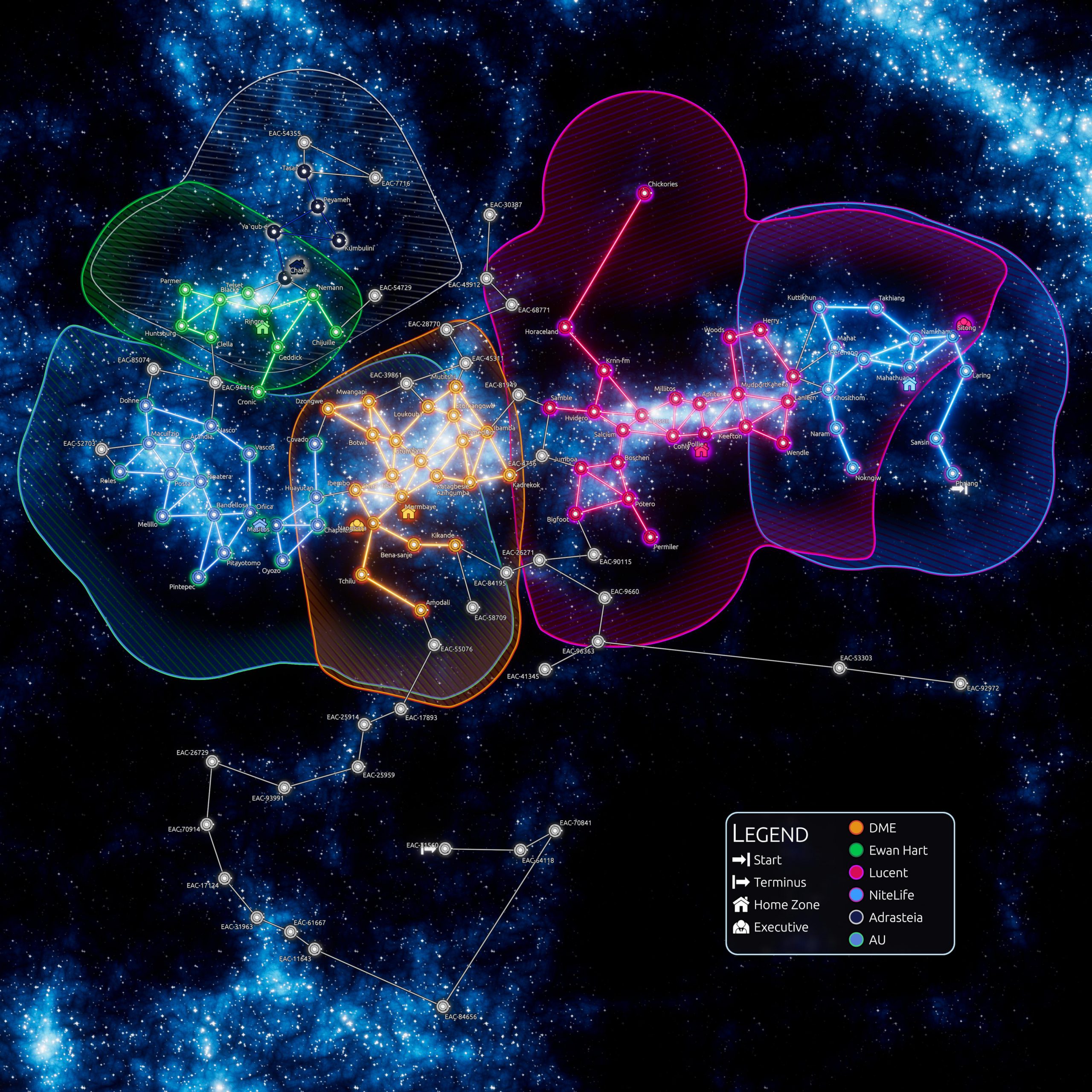
Historical prototype image. Its names, factions, routes, and topology are not current canon; it preserves the design question of how territory and risk become visible together.
Map Pressure
A useful map is a field of commitments rather than a catalogue of destinations. Nodes may represent systems, stations, waypoints, gates, or other scenario-scale places. Links represent routes whose time, access, infrastructure, exposure, and opportunity costs differ.
The map may communicate:
- travel time and resource demand;
- legal access, tolls, inspections, and required credentials;
- supply, repair, rescue, and refit availability;
- security presence, conflict, surveillance, and known hazards;
- contracts, cargo demand, faction interest, and expiring opportunities.
Every displayed claim needs provenance. Route knowledge falls into four useful states:
- known: directly observed or confirmed by a trusted current source;
- forecast: derived from models, schedules, or expected conditions;
- rumor: attributed intelligence that may be incomplete or manipulated;
- stale: once credible, but old enough that reliance carries explicit risk.
The interface should expose source, age, and confidence without pretending confidence is truth. A patrol bulletin, insurer warning, crew report, market quote, faction map, and private sensor pass may disagree for material reasons.
Navigation Loop
The player identifies a destination or obligation, compares plausible routes, inspects what is known and missing, then commits fuel, time, cargo exposure, credentials, or other capacity. New evidence may justify rerouting, pressing on, hiding, seeking confirmation, abandoning cargo, or accepting a worse arrival window.
Arrival state preserves the decision. The ship may arrive late, hot, damaged, visible, low on reserves, politically exposed, or without the margin needed for the next job. A route is therefore part of the encounter, not a line erased when the destination loads.
The local scenario owns what actually occurs along a route. A forecast can shape probability or authored possibility without becoming an advance promise. Generated events, if used, obey the same ownership: they become local facts when the scenario commits them, not because a map seed silently rewrote shared setting history.
Smallest Proof
A coherent navigation proof needs three to five nodes and at least two routes to one meaningful destination. One route should be faster but exposed; another slower or costlier but supported. The player receives information of mixed provenance, chooses a route, encounters one update that permits rerouting, and arrives with consequences traceable to that choice.
The proof succeeds when the player can explain what they believed, why they committed, what changed, and how the arrival state followed. It does not require a procedural galaxy, permanent online world, canonical star map, or large content catalogue.
Local flight and arrival geometry belong to Gravity and Locomotion; emissions, uncertain contacts, and observation during travel belong to Heat, Stealth, and Detection.