End of the Line
Status: historical scope-cut proposal.
Aetheria: Terminusis not a current release target or implementation claim. The destination named Terminus, the crossing, and the player’s circumstances remain developmental; this note does not establish Terminus as canonical geography.
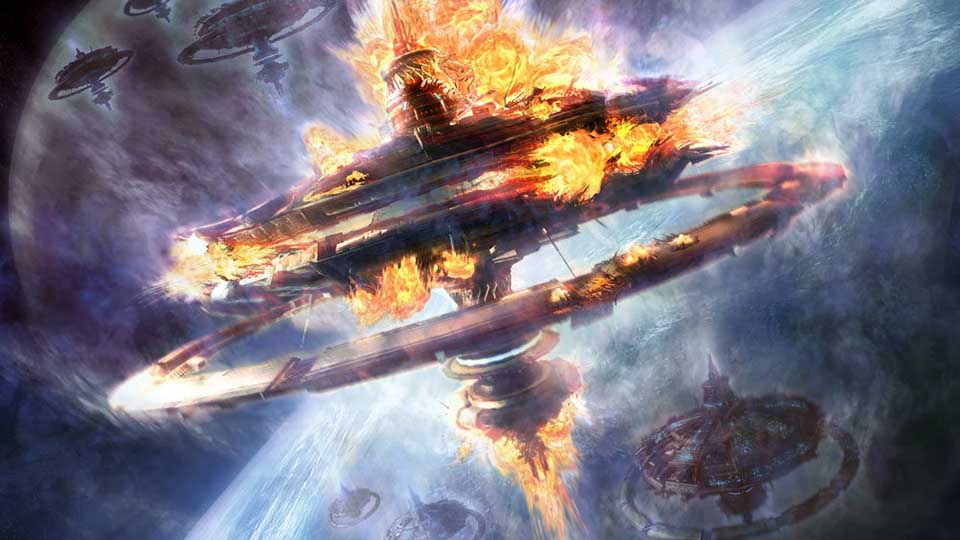
Historical concept art. It is not a canonical depiction or evidence of current production.
Terminus proposed a rogue-lite action RPG about crossing hostile space to win freedom. It reduced the older persistent-galaxy ambition to a route, a ship, accumulating consequences, and a destination. The useful design question was whether Aetheria’s material pressures could hold together without the full strategic simulation.
Proposed Run
A run compressed the crossing into repeated commitments:
- choose a route with incomplete information;
- prepare a ship around limited capacity and known risk;
- fight, evade, bargain, salvage, or retreat;
- carry damage, cargo, debt, and obligations forward;
- reach a bounded victory or lose the material basis for continuing.
The proposal treated ship handling, route choice, combat, trade, repair, and mission consequence as one loop. Corporate power appeared through manufactured equipment, controlled docks, restricted routes, pricing, contracts, and the institutions able to turn survival into debt.
Surviving Design Signal
Action RPG Layer now owns the smallest cockpit proof. Terminus contributes one historical arrangement of that proof: a journey whose arrival state records what the player spent to get there.
As a development path, Terminus can also exercise the seam described in Narrative and Missions without summoning the full persistent world. One generated galaxy supplies world conditions; authored Ink scenes declare semantic dependencies; a resolver binds viable actors and places; scenes export occurrence and evidence; named durable owners accept and commit changes to that history. The single-player scale removes global concurrency and repeated-player access disputes while preserving the architecture the larger world would need.
This is a proving path, not an implementation claim. Terminus does not require the full persistent-world sequel, and using its constraints to test shared foundations does not make its destination canonical.